Market overview: home support
Return to the MPS home page | Go to next page
Overview
Home Support is the delivery of a range of personal care and domestic/community support services to individuals in their own homes to meet assessed needs. The support provided can range from a check to ensure that the individual has taken prescribed medication, through to an extensive care package, including support to get in and out of bed, bathing/toileting and meal preparation and supports people to maintain their independence within their own home.
Home Support is critical to the Council’s ‘Home First’ strategy by providing services that help people stay happy, healthy, and at home for as long as possible, preventing or delaying the need for long-term residential or nursing care.
Our services are commissioned on a place-based approach. Going forward, we are collaborating with the people who use service, families, carers, West Yorkshire ICB colleagues and other partners to transform the way Home Support is delivered by exploring innovate practices that support long-term improvements in service delivery.
Current situation
The current contracts for Home Support started in 2023 and are in place for seven years, ending in October 2030. The District is divided into 23 localities, each served by two contracted providers. Each Provider can cover a maximum of two localities, although some only hold one. There are 28 different providers working in the localities in total.
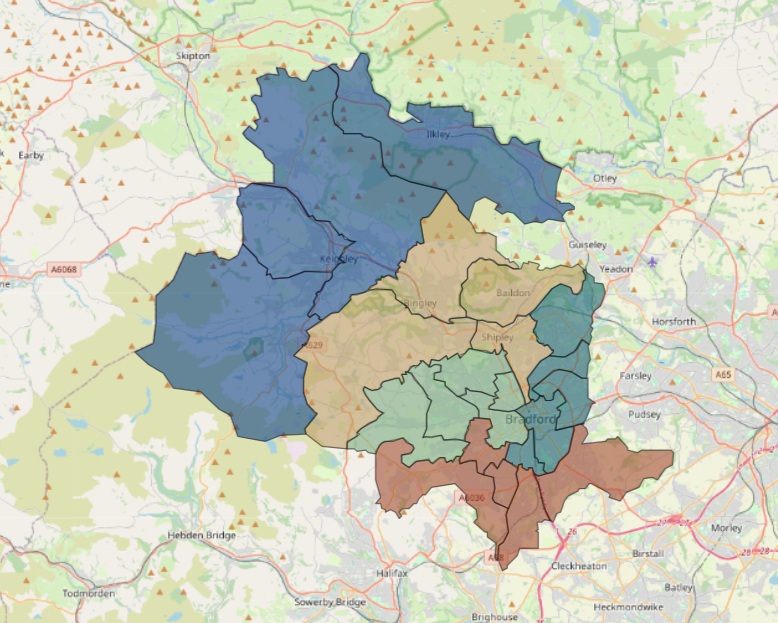
The map above shows the Locality boundaries in the Bradford District.
Each provider delivers between 500 and 1000 hours of care per week per locality. This supports a stable business environment, and no providers have exited the market since the contracts have been in place.
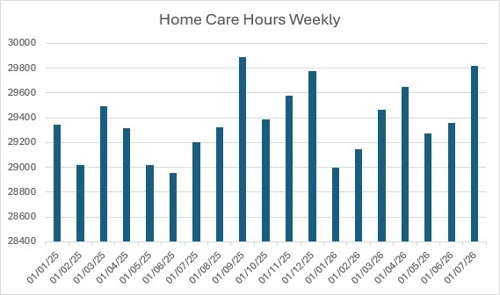
In 2025-26, an average of 29,384 hours of care commissioned by the Council were delivered a Week. Services to older people make up 94% of the care delivered. This is similar to previous years.
Referrals are allocated on a week-on/week-off basis between the locality partners, with packages given a priority category, depending on urgency, such as hospital discharges which require a next-day start. Approximately 90% of all packages have been accepted by provider within two days, and on average packages start to be delivered within 1.59 days.
The localities approach has helped reduce travel time for providers through tighter geographical concentration of packages.
Home Support spend is demand-led, and in 2026-27 it equates to a total spend of circa £39.2m per annum. The current hourly rate for locality providers is £26.12, this sits at the top end of rates within our statistical neighbour local authorities. Bradford benchmark in the second quartile for the home care fee according to the Market Sustainability & Improvement Fund published benchmarking data. This compares favourably with other local authorities, especially given the relatively low operating costs in Bradford.
Future demand
Over the next decade, the most notable demographic growth is expected in older age groups. This shift will place additional pressure on Home Support services, which are predominantly delivered to older people. Whilst the locality model is geared up to meet this demand, alongside these new ways of working are being scoped to meet this challenge and the Council has an ambition to transform the way that Home Support is delivered over the lifetime of the contract.
Five Home Support providers trialled innovations across the District. These pilots focussed on three key areas. Learning and next steps are summarised below:
- Outcome-Focused Support: A programme approach is being undertaken to consolidate learning and consistency across systems to facilitate sharing progress against outcomes between the Council and the provider. This programme approach will ensure shared training, shared documentation and goals across internal and external stakeholders.
- Delegated Health Tasks: Going forward the focus will be on working with the Bradford District Care Foundation Trust to deliver preventative support in line with the NHS 10 year plan to reduce health deterioration. This will be achieved through closer co production and collaboration in training and communication with home support care workers and investment in Home support staff via Health.
- Technology-Enabled Care: Providers trialled using digital tools to monitor wellbeing, reduce isolation, and identify early signs of decline. A full pilot is being undertaken to look at the future of hybrid Home Support and assessments for care will include identifying how technology can support a person’s outcomes and aspirations when a package of care is to be put in place.
These innovations are shaping a more proactive, integrated, and person-centred model of home care, and new providers entering the market will be encouraged to adopt flexible, collaborative approaches that align with this vision.
The Council does not operate any other frameworks for Home Support outside of the locality contracts. New Providers may promote their work via Connect to Support and the Council supports the use of Direct Payments.
Commissioning intentions
The current contracts are in place for seven years – the longer-term arrangements promote stability for the providers and their workforce, as well as allow time to transform the way that care is delivered. Current innovations are in place until March 2026 when learning will be rolled out over the remainder of the contract which is in place until October 2030.
A full review of the service will be carried out in spring 2029, including speaking to the market and people who use services to gather their views in anticipation of incorporating learning and transformation from the current contract into a new tender process in early 2030.
Contact information
For more information and support, or for providers who would like to informally discuss the service and opportunities available, please contact commissioninginbox@bradford.gov.uk
The Service Manager for Joint Commissioning for this area is Alexandra Lorrison. The Commissioning Manager is Jacqui Turner.