Equality, Diversity and Inclusion Cross Cutting Mission 2026 – 2030
Contents
- Foreword from Cllr Kamran Hussain
- Introduction
- Purpose of the Plan
- What do we mean by EDI?
- Why EDI matters in Bradford District
- Legal and Policy Framework
- Bradford District Profile
- Vision and Ambitions
- Equality Ambitions
Foreword from Cllr Kamran Hussain
Portfolio Holder, Neighbourhoods and Community Safety
The delivery of this equalities plan will be fundamental to achieving our ambitions for a strong, fair and vibrant Bradford District where everybody who lives and works here can contribute, thrive and be their best. It signals an active, living, breathing commitment to securing meaningful change in our workplaces, in the provision of Council services and across our communities.
We are building on strong foundations. Bradford has regularly led from the front on ground-breaking approaches to community cohesion; we were among the first local authorities to attach the same weight to low income as statutory protected characteristics in our policy development; our award-winning RESPECT campaign is inspiring a more inclusive and productive workplace.
We have much to be proud of but much more to do. Equality and inclusion are for everyone, but it takes hard graft, creativity, and leadership to keep moving forward. The Plan sets out what we will do acting together as one council to make progress using equalities to help us to manage costs, improve services, promote opportunity and build safer, stronger communities. As Portfolio Holder I am pleased to give the plan my unequivocal support.
Introduction
Equality, Diversity and Inclusion (EDI) plan is a core part of the Council’s commitment to help build a fairer District through the cross-cutting missions which lie at the heart of our District Strategy - tackling inequality and poverty, delivering equitable and inclusive services for all of our residents and their communities, and giving everyone the chance to achieve their full potential.
Bradford District is a place of great diversity, home to people from a vast array of backgrounds and cultures with an equally diverse range of needs, attributes and assets. Our diversity is a strength and part of what makes this such a great place to live and work.
This is a place that is alive with ideas, energy and enterprise. This was vividly displayed throughout our recent year as UK City of Culture. However, this is also a place with its fair share of challenges, where many residents face discrimination, deprivation, disadvantage and other significant barriers to opportunity.
Breaking down those barriers and realising the full productive potential of our 560,000 population needs a public sector workforce that represents and understands its people and places, their differing needs and strengths. Our workforce must have the skills, talents and knowledge required to deliver better, more cost-effective services and improved outcomes for the whole District. To build and retain such a workforce, the Council must be a place where difference is respected and where every colleague feels a sense of belonging, has the chance to thrive, have their say, and represent the communities that they serve.
Our staff, rooted in our communities, are our greatest asset. It is known that an inclusive workplace culture where people are treated fairly, with respect, and given equal opportunities generates better, more cost-effective performance and decision making. This is done by promoting collaboration and innovation, attracting and retaining talent and ensuring strong relationships with customers and communities. Bradford Council must be a place where all our staff feel a sense of belonging.
As EDI is central to securing value for money services and tackling disadvantage, our approach is not limited to meeting legal requirements. It is not a box ticking exercise or about establishing a blanket set of rules. Rather, EDI is embedded into our programme of organisational culture change, providing our staff with the skills and confidence to lead and thrive in a diverse and inclusive environment where difference is valued.
Fundamentally this plan and the actions it commits to are about doing the right things for Bradford District. It reflects our view that everyone should expect fair treatment and have access to opportunities regardless of their background. It will help us recruit and retain the best talent and to deliver value for money services attuned to the needs of our communities. We believe that all Council staff should feel that they belong, be able to succeed here and are committed to creating the environment in which everyone can flourish.
Purpose of the Plan
The Bradford Council Equality, Diversity and Inclusion (EDI) Plan sets out the actions that the Council will take to:
- Meet its legal obligations to comply with the Equality Act 2010 and the Public Sector Equality Duty (PSED);
- Deliver its equality ambitions.
- Embed inclusion across all aspects of workforce policy and practice.
- Strengthen staff wellbeing, engagement and retention.
- Use EDI to secure more cost effective and impactful services.
The Equality, Diversity and Inclusion (EDI) Plan, incorporated within the Council Plan, is closely linked to the delivery of district-wide ambitions and Council priorities as set out in the District Strategy and Council Plan. It acts as a key enabler of organisational transformation and improvement, and the actions it sets out will support the Council and its partners to achieve these aims effectively.
What do we mean by EDI?
For the Council as an employer, EDI is about treating everyone with respect and ensuring that there are equal opportunities, in terms of recruitment, fair treatment in employment and fair and consistent access to development. It is about embedding a culture that values difference and different approaches to doing things. It promotes collaboration and ensures that everyone has the chance to participate and contribute regardless of their background.
Equality is about fair treatment for everyone and providing equal opportunities, whilst recognising that not everyone starts from the same place and some people need extra support.
Diversity is about making sure that individuals’ different skills, knowledge and experiences can be utilised in problem-solving, policy making and service delivery.
Inclusion involves building a workplace where everyone can have their voices heard and no one feels left out. A diverse workforce in itself cannot maximise its impact on outcomes if people are not able to participate.
Why EDI matters in Bradford District
This EDI plan will ensure that the Council meets its legal obligations under the Equality Act 2010 but more than this, it will contribute to delivering good, value for money services and making progress towards our vision, shared with partners, of a Bradford District that is a leader in culture, innovation and sustainability where everyone can live digitally smart, healthy and happy lives, thrive together and share pride in their communities.
Bradford District is among the most diverse places in the country. To meet its needs effectively, identify opportunities and make progress towards our shared vision we need to recruit, retain and develop people from all backgrounds who offer diverse talents, skills and experience, and are understanding and representative of the district and communities that we serve.
A diverse and inclusive Council where people have a voice with the chance to be heard and to collaborate will help to generate the ideas, innovation, critical thinking and evidence-based decision making required to tackle some of the big challenges that we face whilst adapting to changing circumstances and customer needs.
This EDI Plan will contribute to improved Council performance and productivity by:
- Increasing employee engagement and satisfaction
- Assisting in creating an inclusive workforce
- Helping to attract and retain talented staff.
- Promoting new ideas and innovation, helping the Council to adapt to change and build resilience.
- Improving decision making by considering different perspectives and experiences.
- Building stronger relationships with customers and communities
- Enabling the design and delivery of cost-effective services that are in tune with local needs and that increases our chances of getting things right first time.
- Helping to address discrimination and reduce inequality and barriers to opportunity.
These factors will deliver a significant return on investment through reduced recruitment costs and staff turnover, higher levels of innovation and productivity, services tailored to the needs of our communities, and improved outcomes for residents.
This is why the Council aims to build a diverse workforce and a workplace which is fair, inclusive, and where all our staff feel they belong. Council staff are our greatest asset and ensuring that they all have the chance to contribute, to be heard and to meet their potential will help us to achieve the maximum impact from Council services and resources on the District’s future.
Legal and Policy Framework
Our approach to equality is governed by a strong legal framework.
The Equality Act 2010 protects individuals from discrimination in employment, services and public life.
The Act includes the Public Sector Equality Duty which requires public bodies to take proactive action to eliminate discrimination, advance equality, foster good relations between communities and to have regard to equality when exercising their public functions.
The Act also identifies nine protected characteristics. These are:
- Age
- Disability
- Gender reassignment
- Marriage and civil partnership
- Pregnancy and maternity
- Race
- Religion/belief
- Sex
- Sexual orientation
In addition to the characteristics set out by law the Council has two additional locally adopted characteristics:
- Low Income – in recognition of the high levels of income deprivation in Bradford District and the barriers to opportunity and participation that this can present
- Care Experienced - in recognition of the barriers and potential discrimination faced by people who have been in local authority care as children and/or young people.
We all have protected characteristics, for example everyone has an age, race and sex. The Council is committed to considering and understanding the impact of each protected characteristic and our own locally adopted characteristics, on all its decisions and service delivery.
District Strategy 2025-2035
The District Strategy 2025-35, developed through collaboration with District Partners, identifies a collective vision and the following shared ambitions:
- Growth and regeneration
- Strong and Safe Communities
- Healthy and Happy Residents
- A Great Place to Grow Up.
Alongside these ambitions, the strategy identifies two critically important cross-cutting missions - tackling inequality and delivering inclusive services and reducing and alleviating poverty.
The Council Plan 2026 – 2031
This is the Council’s work programme for the next five years and sets out how it will contribute to the ambitions in the District Strategy. It sets out the sort of organisation that we will need to be to maximise the impact of Council resources.
At the heart of the Council Plan are our people – our customers, communities and workforce - and our values - Brilliant, Bold and Balanced. Those values are being embedded through an extensive programme of culture change. This promotes One Council thinking and corporate behaviour across our workforce which will deliver a seamless approach focussed on serving customers and residents. Resources will be deployed where they make the greatest impact, ensuring all council staff are working towards the same overarching goals.
We can only achieve a truly One Council model of delivery if all our staff feel included and have opportunities and the support they need to be heard, to contribute and to develop. The actions incorporated into the EDI Plan will help to secure the inclusive, one council culture needed to drive organisational effectiveness, improved service delivery and better outcomes for our residents, customers, partners, workforce and overall District.
Community Cohesion Framework
The Council’s Community Cohesion Framework aims to build a District where everyone, wherever they live and whatever their background, feels they can thrive, where public services and systems are agile, fair, and collaborative and work together to address challenges and where trust, safety, connection, and shared identity shape public life.
Bradford District Profile
Bradford District is one of the biggest, youngest and most diverse local authorities in the country, and it continues to grow in size and diversity. This scale and diversity mean that the Council must represent, serve, and understand an equally diverse range of interests, needs, and communities.
The district’s assets include over 16,000 businesses with high start-up rates and strengths in digital technology, food manufacturing, engineering and chemicals: huge growth potential with a pipeline of transformational regeneration projects and a thriving cultural sector. Bradford enjoyed huge success as UK City of Culture 2025 and the district includes globally important architectural and industrial heritage and outstanding countryside and open space.
Bradford also faces some significant challenges including high levels of deprivation, inequalities in health, educational, and economic outcomes.
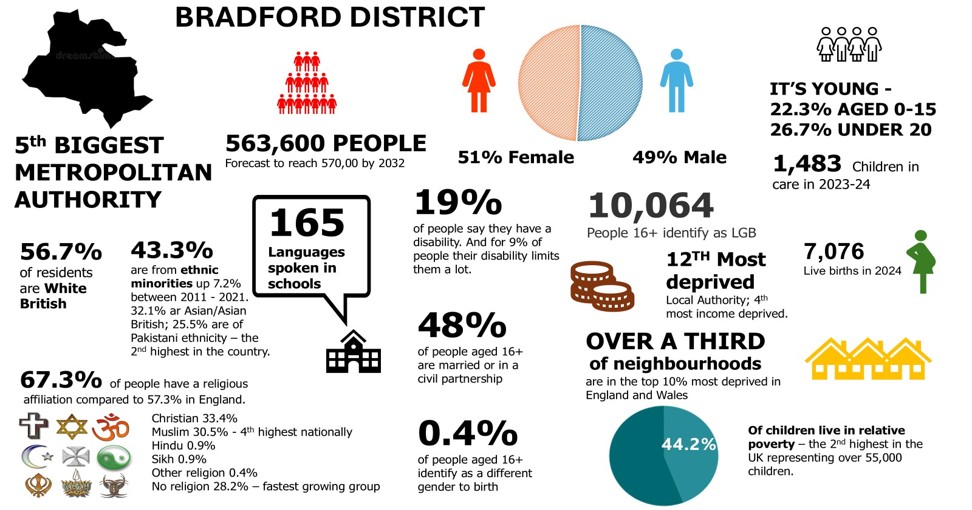
Sources: ONS 2021 Census; ONS 2024 Mid-Year Population Estimates; ONS National Birth Statistics; DHSC Public Health Profile; DWP/HMRC; Bradford Schools Census; Index of Multiple Deprivation 2025.
Vision and Ambitions
Our Council Plan commits the Council to continuing our transformation into a digitally smart, agile, and caring organisation, leading systems and places, delivering quality services, supporting inclusive and sustainable growth, and enabling everyone to be healthy and happy.
The EDI Plan acts as a key enabler of this overall vision through seeking to build a fair, inclusive and compassionate working environment where everyone feels respected, supported and empowered to reach their potential regardless of background, identity or circumstance.
We will deliver this through achieving the following equality ambitions in three key areas. These are:
- Inclusive Workforce
- Inclusive services in design and delivery
- Thriving Communities
The underpinning things that will enable us to deliver this are:
- Leadership and accountability
- Data insight and transparency
- Governance and accountability
Equality Ambitions
Ambition 1: An Inclusive Workforce
A workforce which, at all levels, reflects the communities the Council serves is important. A diverse workforce is an essential way of demonstrating the values of the Council, providing opportunities for local people and making sure that the services offered respond appropriately to the different needs of residents. This representation needs to be reflected at all levels, offering entry level opportunities, progression for staff and encouragement to join the Council into senior and technical roles. For this to be successful, the culture of the Council also needs to be inclusive - a place where staff feel that they can flourish and are feel part of an organisation who values them.
It is important that the council has a working environment where everyone, regardless of their background feels respected, valued and empowered to contribute to their best work, fostering diversity and ensuring all employees are given equal opportunities to succeed and feel accepted.
All staff in the organisation need to know that their development and progression is supported and that their managers are committed to their development. This is even more important for staff from groups which are not well represented in senior roles. A transparent workforce development plan is a key part of this as is the expectations of managers about their role in supporting and encouraging progression.
The Council aims to be a workplace where every employee can grow, acquire new skills and advance in their careers - helping the organisation to thrive through skilled and motivated individuals.
Provision of recruitment and selection training to recruiting managers and interview panels members.
| Ambition 1: An Inclusive Workforce | Actions | 2026/27 | 2027/28 | 2028/29 | Measure |
|---|---|---|---|---|---|
| Ensure that the Council represents the community it serves at all levels. | Further developing of the use of the diverse representatives on employment panels through a formal cross council panel of staff available to do this work | Creation of a pool of suitably trained individuals at all levels within the organisation. | Continue to assess the value added by the group if/when numbers fluctuate. | Continue to assess the value added by the group if/when numbers fluctuate. | Greater availability of suitably trained staff. |
| Review job profiles and continually assess managers’ training to ensure robust decisions are made on attracting talent into the organisation. | Provision of recruitment and selection training to recruiting managers and interview panels members. | Review all job profiles prior to advertisement. Promote the use of the in-built inclusive language tool on the recruitment system. |
Review all job profiles prior to advertisement. Promote the use of the in-built inclusive language tool on the recruitment system. |
Reduction of time to hire rates; Increase in the volume of recruitment, especially in hard to fill roles. | |
| Recruit all entry level staff at Band 6 or below using a coordinated approach that includes community outreach and support for applications. | Bradford Entry to Work programme set up and all band 6 posts coming through this route by Q2 | ||||
| Improve talent acquisition and attraction through providing specialist advice and education for recruiting managers about suitable tools for attracting talent. | Establish the use of wider recruitment advertisement utilising social media platforms and other methods of advertising. | Consider the value added and review the use of wider recruitment advertisement, utilising social media platforms and other methods of advertising. | Consider the value added and review the use of wider recruitment advertisement utilising social media platforms and other methods of advertising. | Reduction of time to hire rates; Increase in the volume of recruitment, especially in hard to fill roles. | |
| Provide support for staff who wish to consider progression Provision of a skills audit |
Create an introduction of formalised development plans for employees who wish to opt-in. Creation of a succession plan identifying hard to fill posts. |
Implement more robust performance reviews, ensuring focus on staff development. | Analyse the performance review mechanism to ensure it fitness for purpose and redesign as appropriate. | Improved employee empowerment and morale. A reduction in staff turnover. Improved succession planning. |
|
| Provision of Coaching, mentoring and reverse mentoring programmes to staff as part of professional development | Develop relevant programmes and assessment tools to monitor effectiveness. The creation and implementation of a coaching programme to assist employee development. |
Annual review of the coaching and mentoring programme. | Annual review of the coaching and mentoring programme. | An increased number of individuals promoted to senior levels. Higher rates of engagement with CPD and improved morale and retention of staff | |
| Develop an exit interview programme to analyse reasons for staff leaving the organisation. Report on findings and implement retention mechanism as appropriate. | Create a robust, data driven assessment of reasons for staff leaving the organisation, with any areas of concerns/emerging patterns flagged to SD’s and an action plan developed if appropriate. Appropriate reasonable adjustments considered. Creation and development of Stay interviews. |
Create a robust, data driven assessment of reasons for staff leaving the organisation, with any areas of concerns/emerging patterns flagged to SD’s and an action plan developed if appropriate. Appropriate reasonable adjustments considered. Continuation of and reporting on Stay Interviews |
Create a robust, data driven assessment of reasons for staff leaving the organisation, with any areas of concerns/emerging patterns flagged to SD’s and an action plan developed if appropriate. Appropriate reasonable adjustments considered. Continuation of and reporting on Stay Interviews |
Reduced attrition rates; reasons for leaving are cited as those outside of organisational control. | |
| A workplace culture where all staff feel respected, safe, heard and have a sense of belonging. | Mandatory cyclical EDI training for all staff as part of their training and development. | To review and update the EDI training offering to ensure its fitness for purpose. | To review and update the EDI training offering to ensure its fitness for purpose. | To review and update the EDI training offering to ensure its fitness for purpose. | Improved levels of staff engagement. Favourable data and metrics from exit surveys and Stay interviews. Increased compliance on EDI training courses and modules and Evolve. |
| A CPD programme that encourage cross council working and offers opportunities for development of all staff. | Managers to assist team members in the process of their CPD. | Promotion of CPD for all staff, to include revised training packages and initiatives. Further engagement with colleagues to develop and coproduce awareness and training provision. |
Promotion of CPD for all staff, to include revised training packages and initiatives. Further engagement with colleagues to develop and coproduce awareness and training provision. |
Better skilled and knowledgeable staff. This can be evidence in the PDR process. Improved completion rates in mandatory and statutory roles. Reduction in complaints for internal and external customers due to higher levels of competence. |
|
| Actively promote EDI initiatives as well as staff networks. | Development of learning packages in co-production with internal and external partners and subject matter experts. | Review the offer of training packages to ensure fitness for purpose. Implement new learning and awareness packages in compliance with emerging statutory/ regulatory developments. |
Review the offer of training packages to ensure fitness for purpose. Implement new learning and awareness packages in compliance with emerging statutory/ regulatory developments. |
An increase in the amplification of Employee Voice and an increase in Active Bystander Interventions including Banish the Banter Improvement of organisational culture. |
|
| Ensure a zero tolerance approach to bullying and harassment. | Effectively communicate the Council’s Zero Tolerance Policy to all staff. | Robust communication from senior leaders stating that unacceptable behaviour will not be tolerated. Revision of policies to ensure compliance. |
Robust communication from senior leaders stating that unacceptable behaviour will not be tolerated. Revision of policies to ensure compliance. |
Reduction in grievances and complaints. Increased staff retention rates. More empowered and motivated workforce. |
|
| Provide internal marketing and communications in accessible formats i.e. plain English, screen reader friendly and legible text. | Conduct an accessibility audit and act upon findings. Conduct focus groups to better understand employee needs. |
Conduct an accessibility audit and act upon findings. Conduct focus groups to better understand employee needs. |
Conduct an accessibility audit and act upon findings. Conduct focus groups to better understand employee needs. |
Increased positive feedback from employees with lived experience. Feedback from the relevant staff networks and other appropriate forums. |
Ambition 2: Inclusive Services in delivery and design
It is important to ensure the front facing services we provide are delivered in an equitable way and reach our communities and we are inclusive of underrepresented groups. We must aim to embed the voices of lived experience in the services we design and deliver. Supporting staff that deliver these vital services is key to our ambition to serve our communities effectively.
Council Departments Service Plans to include equality objectives in all plans. All front facing services departments to have individual EDI goals and deliverables that link to equalities objectives in service plans and EDI ambitions in Council EDI plan 2026-30
| Ambition | Actions | 2026/27 | 2027/28 | 2028/29 | Measure |
|---|---|---|---|---|---|
| Ensure that Council services are delivered in a way that is fair and equitable and inclusive of the needs of all communities. | Service users feedback that reflects the diversity of the district is regularly reviewed and used to improve service delivery and design | To work with the teams/departments collating service user feedback that is reflective of the diverse communities we serve | Review the changes that having feedback from diverse groups has been able to make/influence. Identify what needs to be done further to this |
Review the changes that having feedback from diverse groups has been able to make/influence. Identify what needs to be done further to this |
Feedback is reflective of diverse communities. Feedback has been embedded in service delivery and design |
| Council Departments Service Plans to include equality objectives in all plans | EDI Lead and the policy team support departments to ensure that all service plans have EDI objectives that are both smart and relevant. | To evaluate the effectiveness and changes that the equality objectives had made to the delivery of services | To evaluate the effectiveness and changes that the equality objectives had made to the delivery of services | Number of service plans with equality objectives Review of changes made as a result of the equality objectives |
|
| All front facing services departments to have individual EDI goals and deliverables that link to equalities objectives in service plans and EDI ambitions in Council EDI plan 2026-30 | Briefing and training sessions for managers who are writing Service Plans. Support offered to services from the EDI Lead |
12 month review of progress made by departments Identifying changes the EDI plan has made |
Review and reset of EDI objectives Monitoring of progress made |
Delivery of service EDI plans Changes to services to improve access and usage. Feedback form service users |
|
| Data on service usage is used to identify barriers to participation and solutions are sought by working with user groups | Barriers are identified, and put into an action plan | Action plan is monitored for changes made | Barriers identified are used to inform service delivery/change |
Ambition 3: Thriving communities in the District
We are committed to creating opportunities that help every community in our district feel stable, supported, and connected. We understand that life experiences, disability, background, and economic circumstances can shape the challenges people face. That’s why we work to ensure these factors are considered when developing solutions, building belonging and strengthening communities' resilience, so everyone has the chance to thrive and belong.
| Ambition | Action | 2026/27 | 2027/28 | 2028/29 | Measure |
|---|---|---|---|---|---|
| To provide opportunities for our communities to improve their chances to live a healthy active productive life in the district where their diversity is embraced and outcomes can be improved. | Embedding the Cohesion Framework across the district | Communities Lead and area office teams to work on events showcasing the Cohesion framework Communities lead to work with partners across the district in embedding the cohesion framework Communities lead to work with partners on reporting on hate crime figures The Communities team to continue work on the City of Sanctuary status |
Work with area offices and partners to deliver key events for Islamophobia month, Black History Month, Hate Crime Awareness week Progress/ Update reports to Exec and HWB Boards Work with schools: Deliver sessions in schools on hate crime, critical thinking and cohesion in partnership with BHCA and The Linking Network. Diversity and Cohesion: Organise Civic events for the Holocaust memorial and Remembering Srebrenica Organise a district wide Cohesion Walk with are offices and community organisations |
Establish the area conferences and events that mix communities with VCS and faith partners to promote cohesion Undertake events and reports as mentioned in 2027/28 Tension monitoring: producing guidelines and support for community issues Building on partnership and networking with national and regional bodies |
5 area and one youth Cohesion conference pa Reports to Stronger Community Partnership Board(to be established (Qtr 1) Monthly reports on district hate crime figures Bid submission and CoS renewal February 2026 |
| To influence the equalities outcomes of the district positively by encouraging organisations we procure and commission from, to develop and demonstrate their regard to equality diversity and inclusion. | Ensuring that all suppliers have equal access to commercial opportunities, receive fair treatment and that procurement processes are open and transparent | Review communication and contact with potential suppliers and reach of this process | Including EDI metrics in the evaluation of tender submissions Developing EDI related KPIs in contract management |
Including EDI metrics in the evaluation of tender submissions Developing EDI related KPIs in contract management |
Evaluation of the EDI metrics and EDI KPI’s. |
| Review all procurement forms and processes to include EDI questions | Design and test questions to be asked with potential stakeholders | Ensure all procurement staff are trained in EDI procurement principles | Ensure all procurement staff are trained in EDI procurement principles | Number of staff trained EDI reflected in number of responses received |
|
| Provide support where possible to organisations in developing EDI perspectives and outcomes | EDI lead to work with the procurement team providing briefings sessions on the Procurement and the PSED EDI lead and procurement team to identify opportunities of strategic influence with organisations/ businesses we procure from. |
Provide examples of good practice to share with stakeholders Review Procurement strategy and policy to ensure EDI is adequately reflected |
Provide examples of good practice to share with stakeholders Review Procurement strategy and policy to ensure EDI is adequately reflected |
Collate data on those we procure /commission from and their responses regarding EDI To report on the influence we have been able to have on those we procure/commission from and who this has benefited Review the practice of the suppliers Number of bidders that have an EDI practice and can provide examples Feedback form suppliers Number of challenges raised on the grounds of unfair treatment |
|
| Require those we procure from, to employ from within the district's diverse workforce | As part of social value questions ask bidders to set out their EDI practice and provide examples. | To review the last 12 months of applications received form bidders. To use this info to create a picture of where potential bidders stand on EDI in practice. | To explore ways in which bidders can be supported to move forward with their EDI ambitions | Number of bidders that have EDI practices, policies and examples |
Enabler 1 : Leadership and Accountability
To be an inclusive Council, this needs to be led by all managers in the organisation who need to understand what it means to be an inclusive organisation and what equalities means in practice. All leaders and staff need to understand the part they play, and to be held accountable for this. The aim is to create a productive, positive and high performing organisation, ensuring that leaders are accountable and lead by example, inspiring their teams to do the same. This results in a more motivated and aligned workforce.
| Ambition | Action | 2026/27 | 2027/28 | 2028/29 | Measure |
|---|---|---|---|---|---|
| Ensure leaders actively champion EDI and are held accountable for outcomes. | Mandatory leadership and management training plans are in place for all senior managers. To include a greater understanding of equality, diversity and inclusive practices, promoting the advantages of inclusive workforce. | Map and embed appropriate mandatory training for leaders and managers to provide education and relevant sources of information. Report on compliance and obtain feedback on relevance, impact and quality of training. Workforce EDI Strategy Group to monitor progress of agreed actions. |
Review and amend appropriate mandatory training for leaders and managers to provide education and relevant sources of information. Report on compliance and obtain feedback on relevance, impact and quality of training. |
Review and amend appropriate mandatory training for leaders and managers to provide education and relevant sources of information. Report on compliance and obtain feedback on relevance, impact and quality of training. |
High (increasing year on year) % of leadership teams who have completed mandated EDI training. Satisfaction of quality of training to be consistently high. Annual reporting against KPIs with actions to developed to address any areas for improved compliance and engagement. |
| EDI objectives are included in all performance reviews | Report on compliance and obtain feedback on relevance, impact and quality of training. | ||||
| Embed a culture of inclusivity where leaders and managers model positive behaviours. | Embed positive culture led from the top (senior leadership and management). | Embed positive culture led from the top (senior leadership and management). | Embed positive culture led from the top (senior leadership and management). | Pulse and/or staff surveys to be used as an indicator of success. Exit survey data utilised to drive effective decision making. A reduction in the number of cases citing EDI issues in employee relations casework. |
|
| EDI objectives are included in all service plans and performance reviews. | Realignment of service planning and performance reviews. Guidance to be produced to demonstrate ‘what good looks like’ |
Realignment of service planning and performance reviews to financial year. Review successes/failures from previous year and amend actions accordingly. |
Continue to embed service planning and performance reviews. Review successes/failures from previous year and amend actions accordingly. |
Annual reporting against KPIs with actions to developed to address any areas for improved compliance and engagement. Spot quality assurance testing to take place in a bid to improve actions. |
|
| Achieve and sustain accreditations that demonstrate our commitment to EDI (e.g. Inclusive Employers, Mindful Employers, Fair Work Charter etc) | Working towards various accreditations, evidencing our commitment to EDI, adding to our employee value proposition. | Working towards various accreditations, evidencing our commitment to EDI, adding to our employee value proposition. | Working towards various accreditations, evidencing our commitment to EDI, adding to our employee value proposition. | Increase applicant numbers, especially from individuals from underrepresented groups. |
Enabler 2 : Data Insight and Transparency
To deliver equality objectives, there needs to be data in place that is easy to access and use to inform the work that is undertaken; understand where there needs to be a focus and to provide assurance to staff, Elected Members and the public.
| Ambition | Action | 2026/27 | 2027/28 | 2028/29 | Measure |
|---|---|---|---|---|---|
| Understand performance in delivering the EDI Plan | Set out clear metrics for measuring the EDI actions in the plan and report these to CMT and O&S on a regular basis | EDI metrics agreed that include workforce, service and cohesion and produce a report that is | Regular reporting to CMT and O&S Annual report with the Council Plan in line with the performance framework | Regular reporting to CMT and O&S. Annual report with the Council Plan in line with the performance framework |
Regular reporting to CMT and O&S Annual report with the Council Plan in line with the performance framework |
| Use high quality data to drive change and build a more representative workforce and services. | Improve self-disclosure rates for all protected characteristics. | Develop an internal communications plan to increase engagement on self-disclosure on platforms such as the Employee Self-Service (ESS) portal. | Improved (more representative) monitoring forms embedded as part of the Recruitment Applicant Tracking System (ATS) | Monitor progress on initiatives and act upon findings. | Increased disclosure rates, providing more reliable data. To assist in evidence-based decision making. |
| Regular analysis of recruitment, retention, sickness and exit trends from an equality perspective | Collaborate with teams/ subject matter experts in the organisation to ensure to identify gaps and trends that need to be addressed. | Collaborate with teams/ subject matter experts in the organisation to ensure to identify gaps and trends that need to be addressed | Collaborate with teams/ subject matter experts in the organisation to ensure to identify gaps and trends that need to be addressed | Greater variation of data insights and published reports to inform effective decision making. | |
| All council front facing services understand who uses services and that this use takes account of people with protected characteristics | Ensure that all customer facing services understand who uses their services, either through routine data collection, or through other methods to sample and survey. | EDI Lead to work with departments to identify ways for this to be understood. | EDI Lead and departments to report on progress | EDI Lead and departments to report on what changes this process had made to service development/improvement/change | Customer feedback. Use of dip sample testing |
| Reporting is in place for all equality goals for services and individuals | Reporting built into the Service Planning tools, and the appraisal process | Regular reporting of the outcomes to CMT and action taken to address areas of concern. |
Enabler 3: Governance and Accountability
Governance in the public sector refers to the systems, processes, and policies that guide and lead the administration and management of publicly funded organisations. Effective governance is crucial for promoting accountability, transparency, and responsiveness to the needs of our communities. We consider this to be an important part of how we can demonstrate we are accountable, responsive and transparent in the work we do.
| Ambition | Action | 2026/27 | 2027/28 | 2028/29 | Measure |
|---|---|---|---|---|---|
| To ensure actions are completed in a timely manner. Continue the work of the Workforce EDI Strategy and Steering Groups, respectively | Put in place a Forward Plan for these groups with clear Terms of Reference | Completion of 50% of the actions on the Workforce EDI Steering Group Action Plan. | Review and update relevant Action Plans and Terms of Reference. | Review and update relevant Action Plans and Terms of Reference. | Enhanced trust and credibility, whilst improving overall organisational performance. Promotion of ethical behaviour and integrity. Improved decision making. |
| Ensure engagement and co production with relevant stakeholders | To work with the Staff Networks to understand the lived experience of staff and use this to review policy and practice. | Agree with the Networks the areas where they can support the development of policies and procedures | Review the progress of this work, update and amend, as necessary. | Review the progress of this work, update and amend, as necessary. | Increase employee engagement and morale. Improved brand image and reputation. Reduction in grievances and complaints |
| Ensure that all proposals for the development or change to services, policies in the council are underpinned by good quality EQIAs | Training and resources are provided to support staff to do good quality EQIAs | Create an expert EqIA network made up of staff who can offer guidance and support within their departments on EqIA’s | Number of EqIA’s carried out Cumulative EqIA reporting |
||
| All EqIA’s are stored internally and made accessible for public proposals. | Create a shared resource area for support and storage of EQIAs and make sure all staff are using this. |