Understanding Missing From Care Episodes
Key Points
- Using administrative data, we explored patterns in missing episodes associated with 2,900 looked after children in the Bradford region between 2018 and 2025.
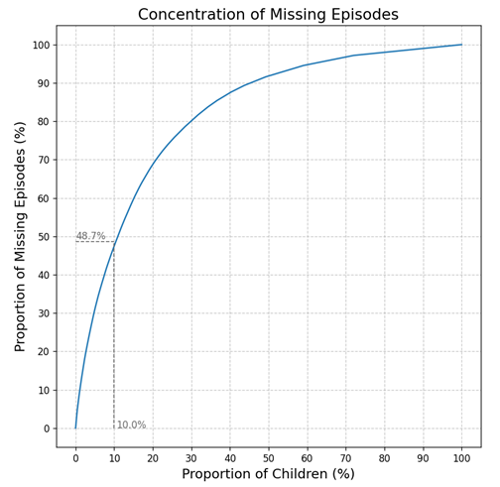
- Of these young people, 16% went missing from care at least once. Missing episodes were highly concentrated within this group, with 10% of missing children accounting for approximately 50% of all missing episodes.
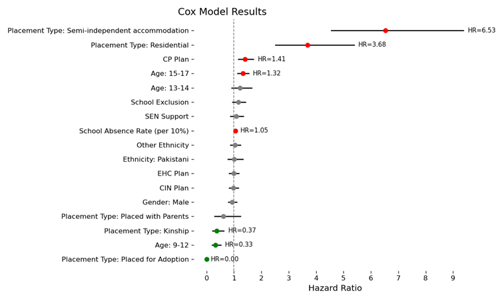
- Children were more likely to go missing if they were placed in residential or semi-supervised settings, were aged over 14, had a previous child protection plan, or had a greater rate of school absence. Children were less likely to go missing if they were placed with family, were adopted, or were aged 12 or under.
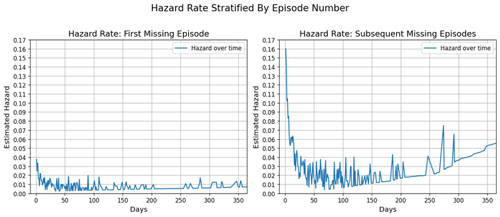
- The timing of missing episodes demonstrates that young people’s risk of going missing is greatest in the first 3 weeks after beginning a placement. In addition, the risk after returning from a previous missing episode is four times greater than for children who have not previously gone missing. This risk initially decays over time but then increases the longer a young person remains in their current placement.
Summary
Using children’s social care data for 2,900 looked after children in Bradford, we examined patterns of risk by analysing over 5,800 missing episodes. Findings highlight that missing episodes are highly concentrated, with a small proportion of children going missing repeatedly and accounting for a large proportion of episodes. The risk of going missing for each child is associated with their placement type, age, and prior experiences. Furthermore, it varies considerably over time, with risk elevated at the beginning of a placement and at its highest in the period after a child has returned from a previous missing episode. Our findings have implications for managing risk and supporting young people in care settings.
Background
In the UK, a person is reported as missing every 90 seconds, amounting to over 350,000 missing incidents per year. Young people make up the majority of missing persons cases, with over 215,000 annual episodes involving children. Going missing can be associated with heightened risks of harm and exploitation; in addition, even where no direct harm occurs, the responses required from police, social care, and wider safeguarding partners are intensive, costly, and place sustained pressure on already stretched services.
As well as being more likely to go missing, children are more likely than adults to have repeated missing episodes. ‘Looked after’ children – that is, children who have been removed from the custody of their parents and live within a social care placement – are a particularly vulnerable subgroup, and are more likely to have one or more missing episodes compared to other children. Despite this, only limited research has been conducted into the factors associated with children – and especially looked after children – going missing, or the patterns in repeat missing episodes. In particular, existing studies have been constrained by limited data on the personal and situational factors linked to missing episodes.
What We Did
Using the Connected Bradford Research Database to access pseudonymised children’s social care records, we collated a dataset of all young people designated as looked-after-children in the Bradford region between 2018 and 2025. This contained demographic data about each child, along with information about the characteristics of each of their placements. We matched these with records of missing episodes and their timing, allowing us to identify the placement associated with each episode. Our dataset comprised 2,900 Bradford-based children, who between them had over 5,800 missing episodes reported across over 5,500 unique social care placements. These data were then linked to pseudonymized Department for Education data to identify per-pupil measures of school absence, exclusion, special educational needs support and education, health and care plan status.
Our primary aims were to explore patterns in the missing episodes, to identify characteristics that may increase or decrease the risk of young people going missing, and to explore the timing of such episodes. To achieve our aim, we applied survival analysis techniques commonly used in public health settings to understand the timing of adverse events. These allowed us to evaluate how various predictor variables impacted the risk of the children going missing within the timeframe of a social care placement.
Key Findings
Concentration
Previous research has established that children in the care system are not only more likely to go missing but are also more likely to have multiple missing episodes. In our dataset, 16.2% of children went missing during the study period: while this is a minority, it is still a much larger proportion than in the general population. In addition, children that went missing at least once tended to go missing repeatedly, with an average of 10 missing episodes in the remainder of their social care placements.
Examining this in more detail, our analysis showed that, for the minority of children who go missing, episodes are highly concentrated, with 10% of missing children accounting for approximately 50% of all missing episodes. The figure below depicts this concentration of missing episodes amongst young people with at least one missing episode.
Exploring the risk of missing episodes
We used survival analysis – a statistical method commonly applied in health research to model whether and when an event occurs – to understand the risk of young people going missing from care settings. Our event of interest is a child being reported as missing, and our time scale begins either at the start of a social care placement, or when a child returns from a previous missing episode.
This approach provides a way to identify which factors are associated with increased or decreased risk of an individual going missing from a given placement. Using a Cox proportional hazards model, we explored the impact of child demographics, characteristics of the social care placement itself, the presence of a child protection plan/child in need plan, and – using additional linked educational data – measures of school absences/exclusions and special educational needs status.
The model produces statistical estimates for each factor expressed as hazard ratios: these are centered on 1, with values above 1 indicating an increased risk (e.g. 1.5 means risk is 50% higher), and values below 1 indicating a decreased risk (e.g. 0.5 means risk is 50% lower).
The figure below shows the model results. For each variable, the point estimate for the hazard ratio is shown as a coloured marker, along with 95% confidence intervals at either side. Non-significant results are greyed out, while significant effects are annotated with the corresponding hazard ratio. Age, ethnicity and placement type categories should be interpreted relative to their reference categories of ‘8 and under’, ‘White’, and being placed in foster care, respectively.
Our analyses demonstrate several key insights. First, several variables had no statistically significant impact on the risk of going missing: these were ethnicity, gender, special educational needs status and prior school exclusion. Second, we find that being placed with a family member (kinship), being placed for adoption and being aged 9-12 decreased the risk of going missing. Finally, several characteristics increased the risk of going missing: being aged 15-17 (the oldest age group), having previously had a child protection plan put in place, and being placed in semi-independent accommodation or residential placements. In addition, increases in school absence were also associated with a small increase in risk.
These effects have implications for targeting preventative efforts; notably, the strongest influences relate to the situational characteristics of placements, with individual factors showing more modest impact. This suggests that environmental features may be more predictive than personal characteristics. However, the apparent link between placement type and missing episodes may partly reflect selection effects. Children with a history of going missing or other challenging behaviour are more likely to be placed in residential settings. As such, higher missing rates in these placements may reflect the unobserved needs and histories of the children placed there, rather than intrinsic risks associated with the placements themselves.
Risk over time
Having identified factors that influence the risk of going missing, we used additional survival analysis techniques to examine how the risk changes over time (We employ a Nelson Aalen estimator). This measure, known as the Hazard Rate, quantifies the risk of a missing episode occurring on each day post-placement. We plotted this separately for 1) the first missing episodes associated with a given social care placement, and 2) subsequent missing episodes involving children who have been returned from a previous episode (i.e. repeat missing episodes).
We observe that, for children who have not previously gone missing, the risk is relatively low overall; however, it exhibits a notable peak during approximately the first 20 days of the placement. For children who have returned to a placement after a previous episode, however, we observe a comparatively high risk over the first few weeks. This risk decays before gradually increasing the longer the child is in that placement.
Next Steps
This research adds important elements to the evidence base concerning missing episodes among looked after children, and has the potential to inform actionable insights to better support young people in care. There remains, however, considerable scope for further work. One limitation to acknowledge is the imperfect way that missing episodes are identified and recorded, and its potential variation across contexts. In more highly supervised placements, opportunities to recognise and record a child as missing are greater, potentially influencing the patterns observed. Future research should further explore the impact of this challenge. It may also be valuable to examine potential selection effects more directly by modelling the sequence of missing episodes in relation to distinct placement types, to better understand how children’s histories and placement trajectories interact over time.
There is also scope to harness richer linked datasets to better capture the trajectories of missing episodes. Here, we relied on relatively simple measures of educational engagement, but more sophisticated approaches incorporating additional data sources could provide deeper insights. The experiences of care-experienced young people are complex and can involve multiple public services, from Child and Adolescent Mental Health Services to the police in both victim and offender roles. Harnessing linked administrative data, such as those available through the Connected Bradford platform, could therefore offer a more holistic understanding of these episodes within the lives of care-experienced young people.
Further analyses could also address a wider set of research questions: Are these patterns also observed for care-experienced young people not placed away from home, or for those outside the care system altogether? How might the geography of missing episodes relate to a young person’s previous residence, school, or wider community context?
Future research could also explore how individual vulnerabilities, the dynamics of different placement types, and broader pressures on children’s services interact to shape missing episodes. These factors are likely to be interconnected, but disentangling their influence is challenging without more integrated data and careful methodological design. Work that bridges across scales, from the experiences of individual young people to practices within placements, to the wider context of service provision, may offer a fuller picture.
Taken together, these future directions underscore the potential for research to move beyond description and towards supporting practical change. Insights from this work can help inform placement stability strategies, targeted early intervention at the start of placements, and more tailored multi-agency support for the relatively small group of young people at greatest risk of repeat episodes.