Case study: Co-producing a Blueprint for an Equitable Early Years System in Bradford

Overview
How can a complex system of services work together to give every child the best start in life? This case study shows how researchers, policymakers, practitioners and local families came together to create a shared vision for early childhood development across Bradford.
Led by Josie Dickerson at Born in Bradford and Hollie Henderson from the HDRC Bradford Evidence-into-Policy Hub, and working closely with the Prevention and Early Help Systems Board, the project combined a decade of research evidence with the experiences of local families and frontline practitioners. The result was an evidence-based blueprint for action that is now helping shape local authority policy and service delivery.
The Challenge
The first years of a child’s life are critical for lifelong health, wellbeing, and education. Yet in Bradford, where around 4,000 of the 7,000 babies born each year live in England’s most deprived neighbourhoods, stark developmental gaps persist. Local data shows that that half these children are starting school without the foundational skills they need to learn, play and thrive in the classroom.
To meet the UK Government’s ambitious Best Start in Life target, that 3 out of 4 children reach a Good Level of Development by age 5 by 2028, Bradford needed more than small, gradual changes. It required a fundamentally new way of working across a sometimes uncoordinated landscape of health, education, and social care services.
The Approach: Bridging Evidence, Policy, and Community Voices
To meet this challenge, Josie Dickerson and Hollie Henderson led a collaborative project working in direct partnership with the Prevention and Early Help Systems Board in Bradford and local communities, to co-produce an early-years system to improve school readiness:
- Grounded in Localised Evidence: Josie and her team used the learning from the last ten years of evaluating early years projects to improve school outcomes, alongside local public health and Born in Bradford data. They presented the high level of need in children and the causes of these problems. This helped partners visualise hidden inequalities across the district and focus on the wider causes of poor health.
- Inclusive Co-Production: The team led a series of iterative workshops engaging over 40 diverse stakeholders and communities across three core groups:
- Senior Leaders and Commissioners setting policy and funding priorities across the Prevention and Early Help Systems Board and Best Start in Life working group.
Frontline Early Years Partners including childminders, private and school nursery staff, and health visitors. - Local Parents and Carers raising young children within highly disadvantaged neighbourhoods and communities.
- HDRC Bradford provided vital links to community groups, ensuring a diverse range of underrepresented voices actively shaped the system built to support them. Using established coproduction techniques, the workshops focused on what works well and what could be better about the current early years system and enabled parents and senior leaders to make decisions as equal partners.
- Senior Leaders and Commissioners setting policy and funding priorities across the Prevention and Early Help Systems Board and Best Start in Life working group.
Reaching a Consensus
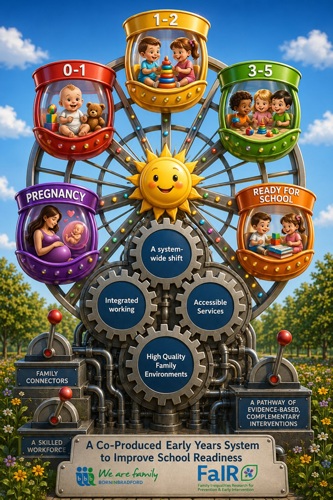
Despite stakeholders coming from different backgrounds, the workshops revealed a strong consensus that Bradford’s current early years system is fragmented and difficult for families to navigate. Workshop participants envisioned a system-wide shift which can be explained through the analogy of a Ferris Wheel, where families board the Ferris wheel at the start of pregnancy, and have a smooth journey as their children grow - receiving seamless, integrated support, and step off the wheel fully equipped for school success. For this Ferris Wheel to run smoothly, services have to work hard and as a single system in the “engine room” to power the wheel. Four important “gears” and three vital “levers” were identified as needed to make the engine work well. The team have published a paper that describes these gears and levers in detail:
Link to the paper: https://openresearch.nihr.ac.uk/articles/6-107
To turn this into actionable change, the team co-produced a Theory of Change. A Theory of Change is a map that joins the dots from what the problem is, to the planned solutions. This provides a blueprint of an early years system to improve school readiness outcomes for all children. The idea is that every area of England can take this “map”, add their own local needs to it, and then translate the actions into a series of plans that are relevant to their local areas and needs. Our Theory of Change can be accessed: https://borninbradford.nhs.uk/a-blueprint-of-an-early-years-system-to-improve-equity-in-childrens-school-readiness/.
A second achievement was the uniting of local services, commissioners, and parents behind a single vision for improving outcomes for children before they start school that they all helped build.
Impact
- Informing Local Policy: The co-produced blueprint of an early years system to improve equity in children’s school readiness provided Bradford Council officers and children’s health commissioners with a practical, consensus-backed framework to directly guide the rollout of the local Best Start in Life offer.
- Informing National Policy: This blueprint will help early years services across England design a system that works better for children and their families.
- Protecting Early Years Investment: By demonstrating how each component of the early years system depends on the others to function effectively, the blueprint gives local and national leaders a robust evidence base and empowers them to advocate for sustained funding against short-term policy and budget cuts.
- A Model for System Change: This work demonstrates that working together, the Born in Bradford and HDRC-supported co-production can successfully bridge the gap between academic research, strategic policy, and the real-life experiences of local families to solve complex public health challenges.
Next Steps
The next step is to encourage other areas across the country to take up this blueprint, and locally, to evaluate how feasible it is to embed the early years system blueprint into local practice, as well as measuring the long-term impact on school readiness and health inequalities across Bradford.